How Regional Live Events Shape Strategy Adaptations Among Swedish Poker Players Under Current Regulations
Mara Hayes · Aug 25, 2026

How Regional Live Events Shape Strategy Adaptations Among Swedish Poker Players Under Current Regulations
Swedish poker players encounter distinct challenges when moving between online platforms and regional live events, particularly as regulations from Spelinspektionen continue to define licensing, venue standards, and player protections across the country. Regional tournaments in cities such as Stockholm, Gothenburg, and Malmö draw participants who must adjust their approaches to account for physical table dynamics, limited session lengths, and compliance requirements that differ from digital formats. Data from regulatory reports show that live events often feature smaller fields compared to major international stops, which influences entry volumes and prize structures under the current framework.
Observers note that Swedish players frequently recalibrate their preflop ranges and postflop aggression levels when transitioning to live settings, where slower pace and direct observation of opponents replace the rapid decision cycles common online. Studies on European gambling patterns indicate that live formats encourage greater emphasis on position play and bet sizing adjustments because participants sit face to face for extended periods. Regional events held in licensed venues must adhere to strict age verification and anti-money laundering protocols, which add layers of preparation that players integrate into their overall routines before each stop on the circuit.
Regulatory Context and Live Event Structures
Current Swedish regulations require all public poker events to operate through approved operators, creating a controlled environment that shapes how regional tournaments schedule breaks, handle chip counts, and enforce time limits. These rules differ from international circuits where fewer restrictions sometimes apply to betting limits or player registration processes. Figures from industry analyses reveal that compliance costs influence prize pools at smaller regional stops, prompting players to evaluate return on investment more carefully when selecting which events to attend throughout the year. And because many tournaments cluster around holiday periods, participants often prepare multiple strategy layers in advance rather than relying on last-minute adjustments.
Live events also introduce variable table conditions that online interfaces cannot replicate, such as seating arrangements and dealer pacing, which force adaptations in hand selection and bluff frequency. Researchers tracking Scandinavian gambling trends have documented that Swedish players at these events tend to incorporate more conservative early-stage play to preserve stacks across longer day-one sessions mandated by venue rules. This approach contrasts with faster online structures where players can reload or switch tables with greater ease.
Strategy Shifts Observed at Regional Stops
Participants at events in southern Sweden, for instance, have been observed tightening opening ranges in early positions while expanding them in later seats to exploit physical tells that emerge over multiple orbits. Data collected through tournament tracking services shows measurable increases in continuation bet frequency during live play compared to online equivalents, partly because opponents cannot hide behind avatars or rapid timing patterns. Those who study these patterns point out that regional events often attract a mix of local recreational players and traveling professionals, creating exploitable tendencies that experienced Swedish competitors learn to target through repeated exposure at the same venues.
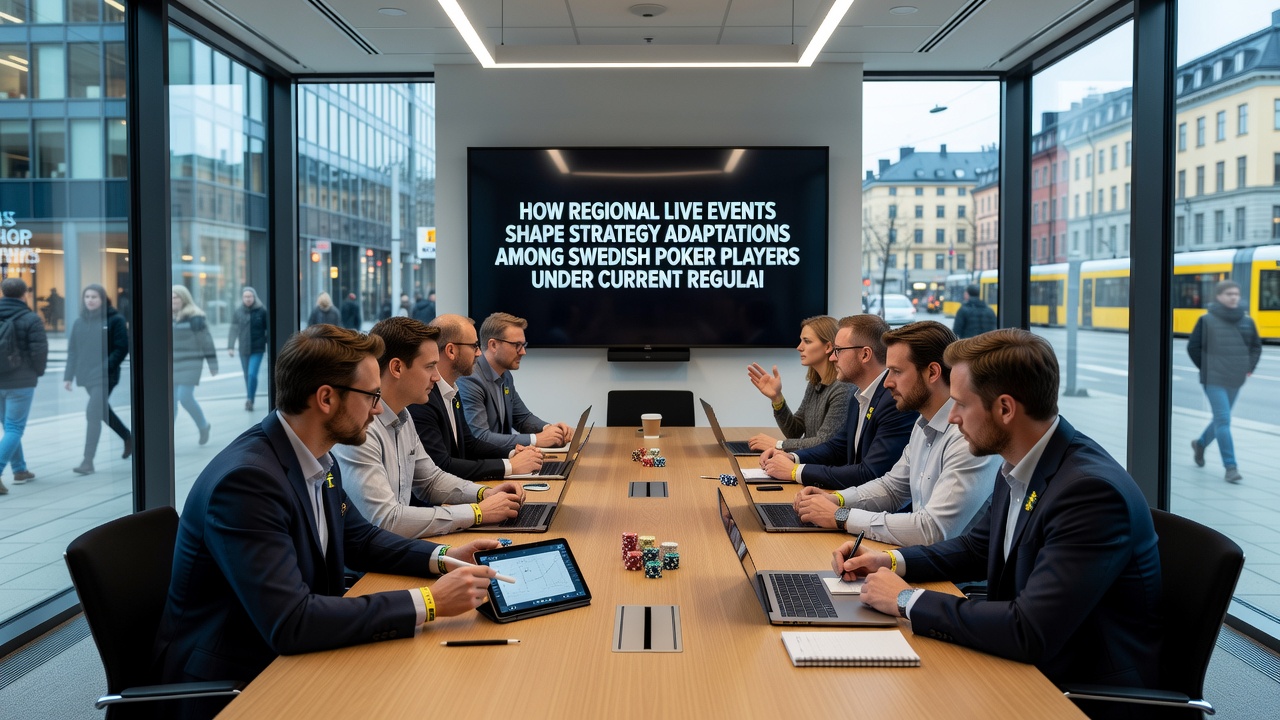
Bankroll management receives additional attention under current regulations because live events carry higher per-session variance due to slower hand volume and potential for extended downswings. Players therefore allocate portions of their bankrolls specifically for regional circuits, treating them as separate from online volume targets. Reports from European research institutions highlight that this segmented approach helps maintain discipline across both formats while respecting spending caps tied to licensed gambling activities.
August 2026 schedules include several regional festivals that combine multiple buy-in levels, giving Swedish players opportunities to test adaptations across different stack depths and payout structures within the same week. These clustered events encourage preparation of modular strategies that can shift quickly from deep-stack survival to short-stack push-fold models as needed. Tournament directors at approved venues enforce consistent rules on verbal declarations and card exposure, which further standardizes the environment and reduces ambiguity that might otherwise appear in less regulated settings.
Long-Term Effects on Player Development
Over multiple seasons, repeated participation in regional live events builds familiarity with regulatory nuances that online-only players may overlook, such as restrictions on electronic device use at tables and mandatory identification checks. This accumulated experience leads to refined time management during breaks and more precise tracking of opponent tendencies across days rather than hours. Analysts following Swedish tournament circuits note that players who balance live and online activity often demonstrate stronger overall results because they develop broader skill sets that transfer between environments.
Collaboration among Swedish players at these events also facilitates shared knowledge about specific venue quirks, including lighting conditions that affect card visibility and table layouts that influence seating preferences. Such informal exchanges occur within regulatory boundaries that prohibit collusion while allowing general strategy discussion during non-play periods. The result appears in gradual refinements to both individual and group approaches that evolve with each new regulation update or venue change.
Conclusion
Regional live events continue to serve as testing grounds where Swedish poker players refine their methods in response to both physical gameplay demands and the boundaries set by current regulations. Adaptations in range construction, bet sizing, and bankroll allocation emerge directly from the structures imposed by licensed venues and oversight bodies. As schedules for 2026 take shape, participants will likely carry forward lessons from prior cycles to maintain competitive edges across an increasingly integrated landscape of live and online options.